
Villa Honey Ltd
KULLAMAA TALU MESI


EAK-accredited testing laboratory L008
🔬 Laboratory data
Iga partii meest on sõltumatult testitud Eesti Keskkonnauuringute Keskuse akrediteeritud katselaboris. Müügis olev mesi on 2025. aasta saagist; allpool leiad analüüsiandmed, mis on teostatud 2023. aasta proovidest (sama tootmismetoodika). Otsin ka muud “2023” mainimised mee kontekstis (tooted, descriptionsid):
Summary of indicators
All indicators comfortably exceed the requirements set out in Regulation No 104 of 20 November 2014 issued by the EU and the Estonian Minister for Agriculture.
| Sample | Humidity standard <20% |
Diastase standard >8 |
HMF standard <40 mg/kg |
Invertase | Electrical conductivity |
|---|---|---|---|---|---|
| 🌸 Pajuõiepärl Rehearsal I · 22 June 2023 |
15,9% | 20,5 | <1 mg/kg | 170 U/kg | 0.30 mS/cm |
| 🌼 Ristikulaine Rehearsal II · 3 July 2023 |
15,9% | 30,1 | <1 mg/kg | 230 U/kg | 0.40 mS/cm |
| 🌲 Metsahõng 18.08.2023 |
18,4% | 56,0 ⭐ | 7.3 mg/kg | 275 U/kg | — |
What do these figures mean?
Humidity <20% — the honey is ripe and has a long shelf life. Diastase >8 — natural enzymes preserved (the honey has not been heat-treated). HMF <40 mg/kg — the honey is fresh and unprocessed. A low HMF level indicates that the honey is neither stale nor heat-treated.
Humidity <20% — the honey is ripe and has a long shelf life. Diastase >8 — natural enzymes preserved (the honey has not been heat-treated). HMF <40 mg/kg — the honey is fresh and unprocessed. A low HMF level indicates that the honey is neither stale nor heat-treated.
🌾 Pollen analysis
Microscopic pollen analysis (melissopollenology) is used to identify the plants from which the honey originates. This determines the honey’s flavour, colour and character.
🌸
Pajuõiepärl
22 June 2023 · 676 views
- 39% Willow
- 38% Cruciferae
- 5% Fireflies
- 5% White clover
- 3% Rosaceae
- 2% Aasristik
- 2% Grass-leaved
- 1% Birch
- 1% Dam
Also, individual seeds of dandelion, mouse-ear chickweed, wood sorrel, bellflower, hawthorn, alder, pine, lilac, buckwheat, maple and others.
🌼
Ristikulaine
3 July 2023 · 692 views
- 47% Cruciferae
- 15% Willow
- 12% White clover
- 7% Rosaceae
- 4% Fireflies
- 4% Aasristik
- 2% Grass-leaved
- 1% Dam
- 1% Heather family
- 1% Dandelion
- 1% Birch
Also present as individual grains: thistle, mouse-ear chickweed, alfalfa, buckwheat, lilac, buckwheat, maple, bloodroot and others.
🌲
Metsahõng
18 August 2023 · 608 views
- 52% Cruciferae
- 13% White clover
- 8% Willow
- 5% Rosaceae
- 5% Tatar
- 4% Dam
- 3% Arujumikas
- 1% Rhinoceroses
Also, as individual seeds: dandelion, common dandelion, common ragwort, meadowsweet, cow parsley, bellflower, alfalfa, forget-me-not, buckwheat, willowherb/deer grass, and others.
🍯 Ingredients of the sugars
Sugar composition of natural honey (by weight).
| Sample | Fructose | Glucose | Maltose | Sucrose |
|---|---|---|---|---|
| 🌸 Pajuõiepärl | 38% | 38% | 1,7% | <0.5% |
| 🌼 Ristikulaine | 38% | 36% | 2,2% | <0.5% |
| 🌲 Metsahõng | 37% | 33% | 1,7% | <0.5% |
Low sucrose content <0.5% proves that the honey has not been processed or diluted with sugar. Natural honey consists mainly of fructose and glucose, which are easily digestible.
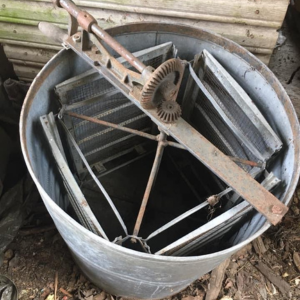
🏛️ Our history
Great-grandfather's barn — our history
This hand-cranked honey extractor belonged to my great-grandfather and symbolises our family’s long tradition of beekeeping. These days we use more modern equipment, but we still adhere to the same principles — gentle handling and unpasteurised honey.
🔬
Accredited independent laboratory
All analyses were carried out by Estonian Environmental Research Centre Ltd — Testing laboratory L008, accredited by the Estonian Accreditation Centre (EAK). The analysis reports and precise methodologies are documented (analysis reports EE23002390, EE23002391, EE23002392, EE23002393, EE23002944, EE23002945).